Understand everyday lives of Indian street vegetable vendors, their struggles, routines, and ways of working.
Our aim was to uncover opportunities, that can be leveraged to compete against rising quick-com platforms selling vegetables
Initial Purpose

Discover
-
Understanding Domain
-
Field visits and observations
-
Semi-structured interviews
-
Literature review
-
Identifying challenges
Define
-
Mapping pain points
-
User personas
-
Framing key insights
-
Problem statement
-
How Might We
-
Information architecture
-
User flow
-
Wireframes
-
Branding
-
Visual Language
-
High-Fidelity Screens
-
Prototyping
Street vegetable vendors struggle with harassment, frequent evictions, and extortion by authorities/intermediaries. Poor infrastructure causes produce spoilage, while restrictive licensing (e.g., Mumbai’s 15,000 licenses for 250,000 vendors)
They face competition from retail chains create economic instability. Most lack social security or formal credit access despite the 2014 Street Vendors Act, relying on high-interest loans. Weak policy implementation leaves them vulnerable to exploitation.
Ideation
Design
Background
Process
What do we want to know

Vendors
Livelihood
How do you usually decide how much stock to buy each day?
What factors affect your daily earnings the most?
Do you feel your income is stable, or does it change often? Why?
Daily Routines
Walk me through a typical day from buying stock to closing your stall?
What do you enjoy most and least about your work?
Infrastructure
How do you transport and store your vegetables during the day?
What challenges do you face in handling your stock?
What happens to vegetables that don’t get sold?
Customer & Market
How do customers usually decide what to buy from you?
Have you noticed changes in buying behavior recently (e.g., supermarkets, online apps)?
Are your regular customers increasing, decreasing, or staying the same?

Financial Practices & Literacy
How do you keep track of your daily sales and expenses?
Do you take loans or credit for your work? From where?
Have you tried mobile payments or UPI? How was that experience?
Social Environment
What challenges do you face with authorities, police, or municipal officials?
Do you have a license or fixed vending space?
What kind of support would make your work easier?
Customers
Preferences
Buying Habits
When and how often do you usually buy vegetables?
What makes you choose one vendor over another?
Do you think vendors provide fair value for money?
What is your preferred mode of Payment and why?
Street vendor vs. supermarket/online app?
Have you shifted your vegetable buying habits to supermarkets or online in recent years? Why?
Based on the secondary research, we prepared a questionarre for user interview
Before heading out to meet Vegetable vendors, we did secondary research to understand their daily life and the challenges they face in India. This helped us get a clear picture of what’s really going on and guided us on where to focus our attention when we step into the field.
Vendors often spend 20–30% of their income on logistics (pushcarts, rented space, transport)
20–25% in urban metros after COVID-19 as buyers shifted online
57.5% face flood problems during monsoons affecting business
70% carry unsold stock home due to lack of storage facilities
Nearly 89% of vendors in India operate informally
FAO estimates 40% of India’s fruits and vegetables are wasted annually due to inefficiencies
Current scenario
India loses close to 40% of fruits and vegetables annually due to lack of proper storage, cold chain, and market inefficiencies. – FAO & FICCI Report (2022)
Vegetable vendors report discarding between 10–15% of their stock daily as unsold or spoiled produce, particularly in urban centers. – ICRIER Working Paper on Retail in India (2021)
Perishability of produce and absence of structured retail infrastructure remain the biggest causes of waste and lost earnings for small vendors. – Ministry of Food Processing Industries (2020)

User Statements
Vendors


Vendors
These statements reveal the daily struggle of street vendors against perishability, storage limitations, and unpredictable demand
बचा हुआ घर ले जाना पड़ता है, वहाँ भी सड़ जाता है
धंधा कम हो गया है
समय के साथ नहीं चलोगे तो कैसे चलेगा
अगर ठंडी जगह मिल जाए रखने के लिए, तो माल दो दिन चल सकता है
सब्ज़ी जल्दी खराब हो जाती है, रोज़ बची हुई फेंकनी पड़ती है
रात में बचा माल सस्ता करके बेचते हैं, थोड़ा नुकसान सही, फेंकने से बेहतर है
What we saw
Unavailability of cold storage decreases the shelf life of vegetables, especially in hot and humid climates
Daily surplus vegetables often remain unsold and are discarded, causing financial losses
They face issues with unclear regulations & unauthorised spaces to sell, affecting safety & income
Dependence on informal transport increases the risk of product damage and loss during procurement
Mulund Market, Mumbai
IIT Market, Mumbai
We conducted semi-structured interviews with vendors and customers to understand their needs, challenges, and motivations.
12
Vendors
We stepped in the vegetable market & realised
Customer’s footfall varies day-to-day and seasonally which results in inconsistent income
Limited access to formal credit limits their ability to invest in and manage their businesses
Poor sanitation, inadequate waste management, and polluted outdoor environments
Customers
These statements reflect customers’ desire for freshness, trust, and familiarity in their buying habits
I believe in buying local to get fresh produce.
I like to pick my own vegetables
Bheedh mein sabzi dhoondhna is a task
Sometimes, if I spot fresh vegetables with a vendor late in the evening, I end up buying just enough for dinner
I order through Swiggy and Blinkit extensively, but try to get fresh vegetables once in a week.
I have been coming here since many years

5
Customers
User Interviews
Ramesh, 34, lives with his wife and young son in a rented one-room home in an urban slum. His wife works as a housemaid and sometimes helps at the stall.
Motivations
Sending money to relatives in the village, saving for a small house and securing education for his son.
He accepts the market shift but dreams of a different, more stable future.


He spends the morning selling until lunchtime, when he takes a break to eat and rest.

Wakes at 4 AM to travel with other vendors to the Vashi wholesale market, buying stock
4:00am
he returns and sets up his stall, arranging vegetables carefully to attract buyers. Presentation matters
6:00am
Morning–Noon
Afternoon
He takes a break, Scrolls youtube reels, video call back home.

He continues selling until 10:30 pm.
Despite long hours, income remains unstable usually between ₹500–₹1,200 daily


Around 10% of his stock goes unsold and spoils each day due to lack of proper storage
Ramesh is aware of the rising competition from supermarkets and online grocery apps. and customers are shifting away,
Meet Ramesh
Journey Mapping
Procurement & Setup
Morning Sales
Afternoon Lunch/Rest
Evening Sales
Closing & Wrap-up
4am - 6am
6am - 11am
12pm - 4pm
Source fresh produce, prepare stall
Attract and serve customers
Recharge, plan evening,
Eat, rests, Watches
reels
Stages
5pm - 9pm
9:30 pm onwards
Goals
Maximize sales, clear inventory
Reconcile earnings, Clear and Pack up stall
Actions
Buys from main market, transport, set up and display vegetables
Greet, negotiate, weigh, bag, manage cash flow
Handles crowds, upsell, fast transactions, discounts
Pack or throw leftovers, clean
Activity Graph
vendors engagement during the day
Touchpoints
Market, suppliers, transporters
Customers, weighing scale, cash box
Stall, phone, neighboring vendors
Customers, helpers, weighing scale, cash box
Stall, cash box, cleaning supplies
Pain Points
Price fluctuations, transportation delays
Bargaining stress, insufficient change
Low sales, fatigue, heat/discomfort
Crowding, errors in calculation, theft risk
Waste, leftover stock, post-market safety
Opportunity
Areas
Direct sourcing partnerships, shared transport
POS solutions/apps, loyalty schemes
Midday engagement offers, ergonomic upgrades
Digital inventory and billing tools
Cooperative late sales, food waste tie-ups
User Flow
Information Architecture
VENDOR
VENDOR
Onboarding Flow
Open App
Logged In
Creating your stall page
Stall page
Go Live
Listing your vegetable
Listing Page
Listed
CUSTOMER
Onboarding
Buying vegetables based on a recipe
Open App
Recipes
Go to cart
Logged In
User Flow
Information Architecture
CUSTOMER
User Flow
Information Architecture
VENDOR
VENDOR
Onboarding Flow
Open App
Logged In
Creating your stall page
Stall page
Go Live
Listing your vegetable
Listing Page
Listed
CUSTOMER
Onboarding
Buying vegetables based on a recipe
Open App
Recipes
Go to cart
Logged In
User Flow
Information Architecture
CUSTOMER
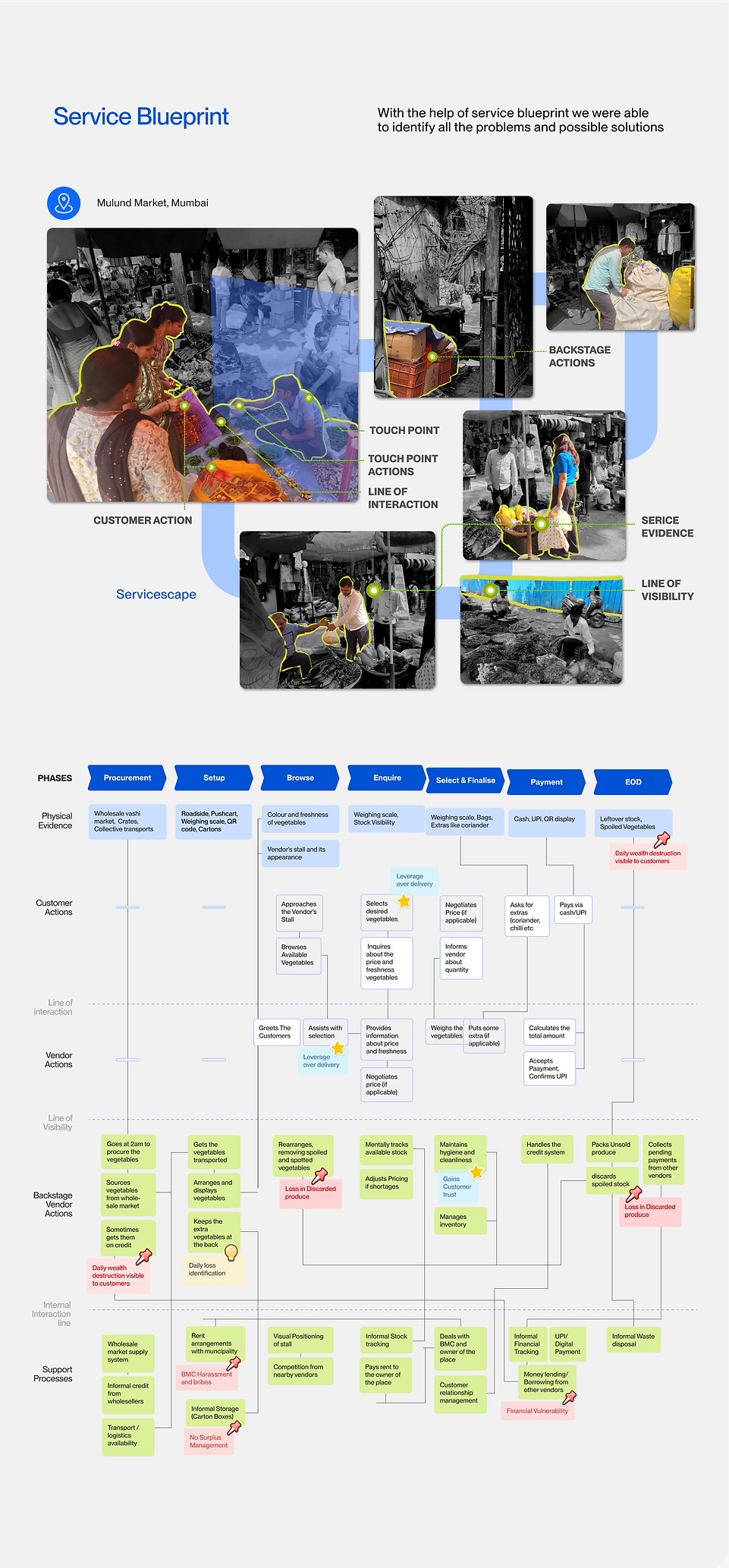
Methodological Triangulation
Observational
Mapping vendor routines and closing-time behaviors
Servicescape
Service Blue print
Footfall & Timing Patterns
Physical Constraints
lighting, mobility, and negotiation culture
Insights
We used methodological triangulation by combining interviews, observations, and secondary data to study the same problem from multiple angles. This strengthens the validity of findings and ensures the insights reflect both what people say and what they actually do.
Primary Sources
User Journey
Vendor Interview
Customer Interview
Initial market research-
food wastage and Storage issues - data on scale and socio-economic impact
Stake holder Mapping
Secondary Sources
Problem Statement
Out of scope
In scope
-
Rural vegetable vendors, wholesale vendors, or supermarket retailers.
-
Implementation for cold storage systems for vendors.
-
Arrangement for delivery of vegetables
-
Mediating disputes post-purchase.
-
B2B or large-scale buyer-seller matchmaking
-
Large-scale waste management or municipal policy reforms.
-
Urban roadside vegetable vendors working in daily informal markets.
-
Customers buying from vendors and use online delivery apps
-
Urban street vegetable vendors with smartphones and willingness to learn
-
Urban areas with established street vendor ecosystems
Assumptions
-
Vendors have smartphones.
-
Internet connections
-
Vendors are open to adopting new tools
-
Customers are motivated by discounts/surplus offers.
-
Spoilage rates vary seasonally but are consistently significant enough to affect income
-
Vendors are open to discounting unsold stock.
-
Increased sales directly translate into measurable reductions in food waste.
Customers, still value buying from street vendors as it gives them the ability to personally select fresh vegetables, negotiate prices, and build trust through this relationships.
This supply-demand disconnect creates vendor income instability. Customer shift to online platforms for ease while paying higher prices.
This eventually leads to economic losses for vendors and Food wastage.
Urban street vegetable vendors struggle with unsold produce
at the end of the day due to storage limitations and unpredictable footfall, which leads to losses for vendors and food wastage
DIVERGE
CONVERGE
Urban food distribution systems fail to efficiently connect surplus produce with local demand.
This disconnect creates food wastage and amplifies both economic losses and food insecurity.
As informal workers, vendors lack financial tools, credit access, and systemic support.
This instability adds to their problems and prevents them from adapting to changing market
conditions or investing in better solutions
Customer footfall is unpredictable and increasingly reduced by quick-commerce platforms.
Fewer walk-in customers mean more stock remains unsold at day’s end.
They have limited or no affordable storage options, and vegetables are highly perishable.
This forces them into a “sell today or spoil tomorrow” cycle.
Street vendors face economic losses due to daily food wastage and unsold products.
Because they cannot sell stock quickly enough before it perishes.
Provide vendors with a simple digital tool to list vegetables at discounted rates before day-end.
This creates visibility for unsold stock
Integrate customer discovery through a map-based/localized app.
Nearby customers can find affordable deals, increasing vendor sales and reducing waste.
Enable basic inventory and credit tracking within the app.
This helps vendors better estimate demand, manage stock, and track repayments.
Support adoption with training, intuitive onboarding and local Language support.
Ensures vendors actually use the system despite low digital literacy barriers.
Vendors reduce spoilage, stabilise daily income, and retain local customer trust.
Strengthens vendor livelihoods while cutting food waste and giving customers fresher, cheaper produce.
Why
Urban street vegetable vendors struggle with unsold produce at the end of the day due to storage limitations and unpredictable footfall, which leads to losses for vendors and food wastage
User Persona
Education
Family Status
Stays in
Occupation
Shop Location
Phone
Primary School
Married, 3 children
Mumbai
Vegetable Vendor
Powai market
Smartphone
Ramesh dada has been a vegetable vendor for over 15 years. His father started this business of selling vegetables. He is committed to his business and work long hours from early morning until late at night. He is motivated to work harder to provide for his family.
Aspirations
Pain Points
-
No cold storage
-
Low digital literacy
-
No knowledge about govt. schemes
-
Perishable Vegetables
-
Space Limitations

Constraints
-
Stable income
-
Regular customer base
-
Reduce spoilage
-
own a small home
Ramesh
37, M
-
Unpredictable Income
-
Spoilage
-
Customer shift to online platforms
-
Credit Management
-
Harassment by BMC and Police
-
Physically Demanding
Aspirations
Pain Points
Constraints
-
Time Constraints
-
Higher prices compared to street vendors on apps
-
No ability to handpick vegetables
-
Inconsistent freshness
-
Struggles to visit markets regularly
-
Availability of fresh vegetables online
-
Lack of help from family to do daily chores
-
Cannot always shop physically
-
May not know about surplus discounts
Education Family Status Stays in Occupation
M.Tech
Married, Mother of one
Mumbai
IT Company Job
She was born and brought up in Mumbai. She got married at the age of 29 and now
is a mother of a 6 year old boy. She works from home and goes to office once a week.
She prefers buying fresh vegetables at least once a week from the vegetable market.
Due to her busy schedule, she has to rely on delivery apps.

Anjali Kapoor
34, F
-
Fresh produce at fair prices
-
Enjoys physical selection when possible
-
Hopes to support local vendors
-
freshness, pricing, and hygiene
-
her family eats fresh, healthy, and safe food.
Why
Why
Why
Why
How
How
How
How
How

Who are we designing for?
//IDEATION
How Might we?
How Might We statements helped us reframe the problem into opportunity areas, guiding ideation toward solutions
How might we
Empower urban street vendors to get more customers on a regular basis?
Top Ideations
Geo-tagging vendors so customers see who is nearby
Vendor profiles on local marketplace apps with ratings/reviews
Partnership with residential societies
Other ideas
QR-code posters of vendors in locality
Referral discounts for regular customers bringing new buyers
Partnerships with nearby businesses
Group promotions (clusters of vendors together)
Digital marketing guides for vendors
Vendor story highlights in local social media groups
How might we
Minimise food wastage among vendors?
Top Ideations
Community exchange/signup for surplus sales
End-of-day discount alerts
Daily sales tracking and management tool
Partnerships with local NGOs for donation
Other ideas
Connect with bulk buyers
Share unsold items via group chat
Real-time expiry tracker
Partnerships with nearby businesses
Reminders for perishable stock
Vendor collaboration on surplus days
Recipe cards for leftovers
Composting stations
In-app promotions
How might we
Enable customers to easily discover trustworthy everyday vendors?
Top Ideations
Verified vendor profiles
Map-based daily vendor updates
Customer review and rating system
Filter for experience and reliability
Other ideas
Vendor introduction videos
Referral rewards for customers
Personalized recommendations based on past purchases
Trusted Vendor of the Week
Chat function for queries
Real-time availability status
Feedback prompts after purchase
How might we
Streamline inventory and payment processes for vendors?
Top Ideations
Inventory tracking mobile app
Auto reminders for reordering supplies
Payment tracking diary
Voice input for inventory updates
Other ideas
Daily sales analytics dashboard
E-receipts and invoices
Shared vendor accounting platform
Vendor-to-vendor borrowing network
Expense tracker integrations
Predictive demand suggestions
Initial Ideations
Initial ideations explored concepts like surplus redistribution, dynamic pricing, and community pick-up points, but were set aside due to feasibility and scalability challenges
Selling in higher prices
Can be hired on hourly basis
Service enabler
Sells seasonal,
vegertables - can be a subscription model
at cheaper prices
If some vegetables are still not sold they can be donated
A digital platform where vendors could sell end-of-day surplus produce to restaurants and caterers at discounted rates, minimizing waste and ensuring steady income. It was rejected as it required complex coordination, real-time inventory management, and high vendor digital adoption, making it less feasible for street vendors.
We didnt work on this idea due to operational complexity in real-time coordination.
Potential Failure
1
Design an interactive digital simulator, to teach basic digital literacy skills. Accessible via smartphones or community centers, it will support regional languages. The simulator will incorporate real-world, practical scenarios that resonate with the daily activities of vegetable vendors.
Potential Failure
2

Vendors may feel intimidated by digital tools or resistant to adopting new technology. They might not engage with the simulator regularly due to lack of motivation or time.


Visual language
The visual language of the app was designed to align with the UX goals of accessibility, low cognitive load, and transparency. The interface follows a clean, minimal, and icon-driven visual system that supports quick recognition over reading
Mukta/मुक्त
Typeface
H1
H2
H3
H4
Heading
Sub heading
Body
Small
24px
20px
16px
14px


Regular
Lorem Ipsum is simply dummy text of the printing and Lorem Ipsum has been the industry's standard dummy text ever since
Bold
लोरेम इप्सम लैटिन भाषा का एक मानक डमी टेक्स्ट है, जिसे डिज़ाइन में प्लेसहोल्डर के रूप में इस्तेमाल किया जाता है, और यह हिंदी में भी उसी तरह काम करता है।
Colours
HEX: #00A63E
RGB: 0, 166, 62
Primary Colour
HEX: #00A63E
HEX: #B0D615
RGB: 176, 214, 21
Primary Colour
HEX: #B0D615
RGB: 0, 166, 62
Primary Colour
RGB: 176, 214, 21
Primary Colour
HEX: #00A63E
RGB: 0, 166, 62
Secondary Colour
HEX: #00A63E
HEX: #00A63E
RGB: 0, 166, 62
Secondary Colour
HEX: #00A63E
Tertiary Colour
HEX: #6A7282
RGB: 106, 114, 130
Tertiary Colour
HEX: #003223
RGB: 0, 50, 35
Tertiary Colour
Tertiary Colour
Tertiary Colour
RBB: 0, 0, 0
HEX: 000000
Tertiary Colour
RGB: 0, 166, 62
Secondary Colour
RGB: 0, 166, 62
Secondary Colour
Logo

Rooutes
Roots + Routes